villa khosta

villa khosta
Private Villa
Russia, Sochi
2025
Concept
Stanislav Kozeen, Marcelo Rueda, Ulia Grishina, Ekaterina Tsyganenko, Alexandra Glazova
Architecture
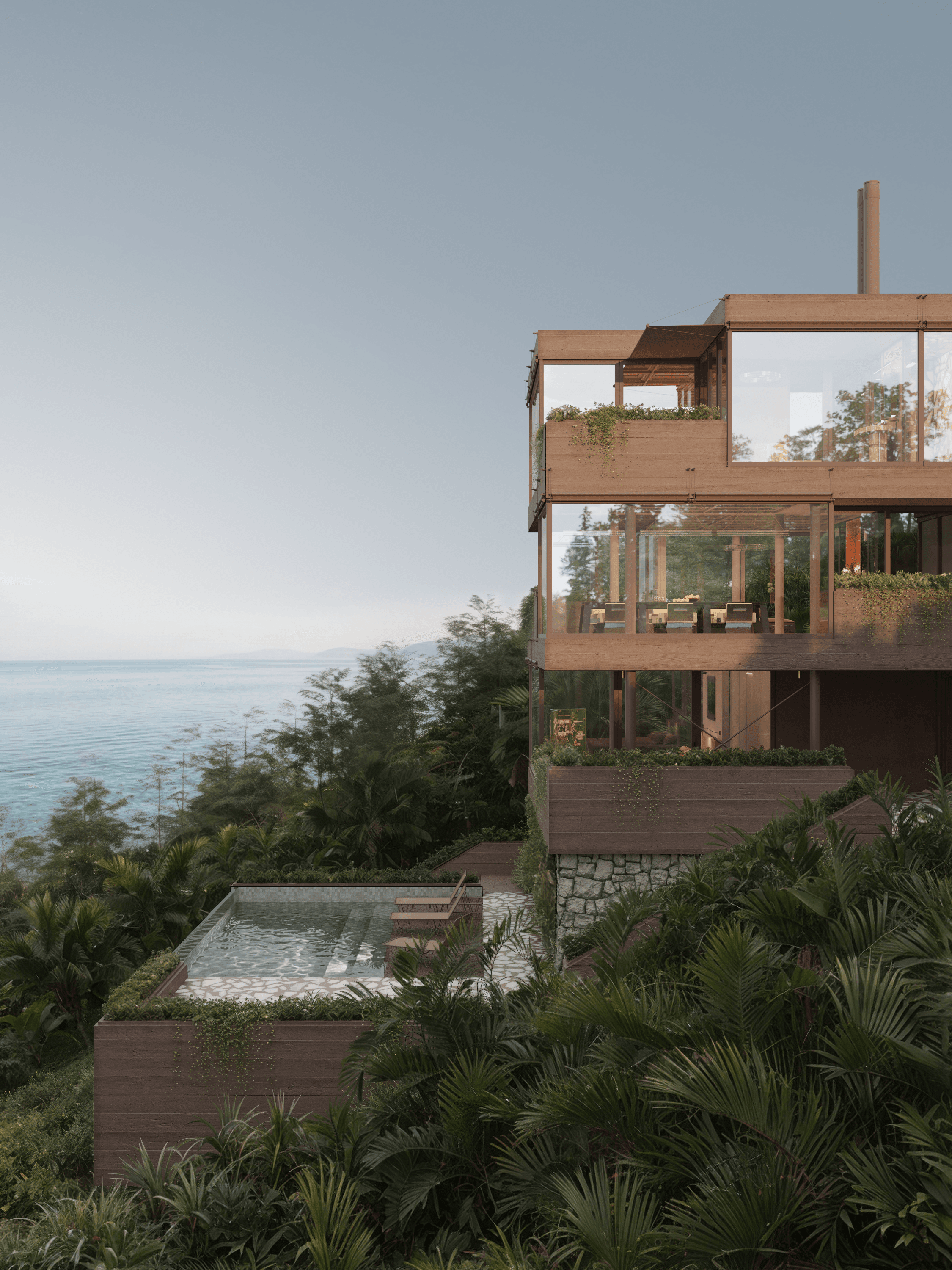
A narrow, elongated plot with a steep slope and driveway access from the top dictates a vertical approach. The three-story, brick-shaped house is placed at the highest point of the site — making the most of the elevation change without digging too deep into the slope.
Red concrete (terracotta) was chosen deliberately. It is the color of sun-warmed Sochi clay and the crumbly rock that holds this slope together. The house reads as a man-made monolith where the voids in the volume are floor-to-ceiling windows. No unnecessary details. Just concrete, glass, and greenery.
Balcony Composition
The balconies are arranged in a staggered, chessboard pattern, jumping from one side of the facade to the other as you move up floor by floor. This is not just a formal gesture — it’s a practical one. Sunlight and air reach deeper into the house, and the vertical lines of greenery never block each other.
Every floor has direct outdoor access. All balconies are immersed in large plants and vines. You feel like you are living inside a tree canopy — even on the third floor. Foliage sits between you and the sea, not just outside the window.
Space and Movement
A swimming pool sits halfway down the plot, roughly level with the second floor, cut directly into the slope. It acts as a visual anchor. From the upper terrace, you look down at the water. From the water, you look back at the house and the sea.
Terrazzo flooring runs as a single continuous layer through the interiors, across the open terraces, and around the pool area. This merges inside and outside into one space. You do not cross a threshold — you simply flow from the room onto the terrace.
Interiors and Contrasts
Inside, an unexpected turn: a coffered ceiling. Classic square recesses enter into a dialogue with the rough texture of the terracotta concrete walls. Cool, polished marble and dark oiled oak create a calm, deep atmosphere. The oak softens the acoustics. The marble adds tactile variety.
Exterior Materials
The facade is terracotta concrete — a material that ages well, becoming richer over time. The retaining walls, holding the pathways and the pool in place, are made of rough rubble masonry. This is not decoration. It is honest stonework.
Together, concrete, rubble stone, terrazzo, marble, and oak produce an architecture that is both tough and warm. A fortress cut into the hillside, where every day offers a stunning view of the Black Sea.

Architecture
A narrow, elongated plot with a steep slope and driveway access from the top dictates a vertical approach. The three-story, brick-shaped house is placed at the highest point of the site — making the most of the elevation change without digging too deep into the slope.
Red concrete (terracotta) was chosen deliberately. It is the color of sun-warmed Sochi clay and the crumbly rock that holds this slope together. The house reads as a man-made monolith where the voids in the volume are floor-to-ceiling windows. No unnecessary details. Just concrete, glass, and greenery.
Balcony Composition
The balconies are arranged in a staggered, chessboard pattern, jumping from one side of the facade to the other as you move up floor by floor. This is not just a formal gesture — it’s a practical one. Sunlight and air reach deeper into the house, and the vertical lines of greenery never block each other.
Every floor has direct outdoor access. All balconies are immersed in large plants and vines. You feel like you are living inside a tree canopy — even on the third floor. Foliage sits between you and the sea, not just outside the window.
Space and Movement
A swimming pool sits halfway down the plot, roughly level with the second floor, cut directly into the slope. It acts as a visual anchor. From the upper terrace, you look down at the water. From the water, you look back at the house and the sea.
Terrazzo flooring runs as a single continuous layer through the interiors, across the open terraces, and around the pool area. This merges inside and outside into one space. You do not cross a threshold — you simply flow from the room onto the terrace.
Interiors and Contrasts
Inside, an unexpected turn: a coffered ceiling. Classic square recesses enter into a dialogue with the rough texture of the terracotta concrete walls. Cool, polished marble and dark oiled oak create a calm, deep atmosphere. The oak softens the acoustics. The marble adds tactile variety.
Exterior Materials
The facade is terracotta concrete — a material that ages well, becoming richer over time. The retaining walls, holding the pathways and the pool in place, are made of rough rubble masonry. This is not decoration. It is honest stonework.
Together, concrete, rubble stone, terrazzo, marble, and oak produce an architecture that is both tough and warm. A fortress cut into the hillside, where every day offers a stunning view of the Black Sea.


